Blog.
Articles for entrepreneurs — how to choose an office in Prague, how to start a business, and what to keep in mind when building a company.

VAT control statement in Czechia — who files it, deadlines and penalties
The VAT control statement is one of the routine obligations that in Czechia concern VAT payers only. It is not a VAT return nor a recapitulative statement — it is a separate electronic report in which the tax authority matches invoices received and issued between companies. For an honest business it is routine; it causes trouble mainly when it is forgotten or when the reply to a challenge comes late.
Read
Work activity agreement (DPČ) in Czechia 2026: limits, contributions, and how it differs from the DPP
More flexible than a standard contract, but with a higher hour ceiling than the agreement to complete a job. The work activity agreement has clear rules for 2026 — how many hours you can work under it and from when contributions apply.
Read
Financial statements of a Czech s.r.o. and their publication in the collection of deeds — obligations and deadlines
Who must publish the financial statements, where and by what route, by when it has to be done, and what a company does not have to publish. A practical overview of the obligations and deadlines around the collection of deeds for a Czech s.r.o., with the rules in force in 2026.
Read
Paying out a profit share (dividends) in a Czech s.r.o. — procedure and tax
How a profit share is paid out in a Czech s.r.o. — from approving the financial statements through two mandatory tests to a 15 % withholding tax and the deadlines. A practical overview for shareholders and directors, with figures valid in 2026.
Read
Suspending a trade licence in Czechia — how to pause your business and what about contributions
Suspending a trade licence lets you pause your business without losing the licence itself. How to notify the suspension, what happens to social and health insurance advances, and how it differs from full cancellation — an overview for the self-employed.
Read
Income tax advances in Czechia — who pays them, how much and when
Income tax advances spread the tax across the year instead of one payment after the return. Whether you pay them, and how much, depends on your last tax figure. An overview of who pays advances, how much and by when — for sole traders and limited companies alike.
Read
Minimum and guaranteed wage in Czechia 2026 — what it means for employers
From January 2026 the minimum wage in Czechia rises to CZK 22,400 a month, and at the same time a major change is settling in — the guaranteed wage in the private sector has ended. For an employer this means a simpler rule, but also a higher pay floor. An overview of exactly what applies and what it affects.
Read
Director's remuneration in a Czech s.r.o. — how it is taxed and what is better
A director who runs their own s.r.o. cannot simply withdraw the company's money — it has to be paid out through a specific route. The two most common are a fee for holding the role and a share of profit, and each is taxed differently. The gap between them decides how much of the company you actually take home.
Read
Free, craft and regulated trades in Czechia: which licence you need
In Czechia you don't run a business on "one trade licence". The law distinguishes several types, and which one your activity falls under decides whether a simple notification is enough or you must prove education, experience or state approval. Here's the overview that places you from the very start.
Read
VAT-identified person: when buying services from the EU makes you one
As a non-VAT payer you assume the tax doesn't concern you. Yet a single invoice for Google ads or foreign software can turn you into a VAT-identified person — regardless of the amount. Here's what it means and what to do.
Read
Business premises vs registered seat in Czechia — the difference and what you need
"Seat" and "business premises" sound similar but mean different things. The registered seat is the company's official address in the commercial register; the premises (provozovna) are the place where the activity is actually carried out and which is notified to the trade licensing office. Here is how they differ and when a seat alone is enough.
Read
Agreement to Perform Work (DPP) in Czechia 2026 — limits and contributions
The agreement to perform work is the most flexible way to cover occasional work in Czechia without a full employment relationship. Over the past two years, though, it has changed more than any other form of employment — the contribution threshold has moved, a reporting duty towards the ČSSZ has been added, and some announced changes were scrapped before they ever took effect. Here is what applies for 2026.
Read
Register of beneficial owners in Czechia — who, where and by when
Alongside the entry in the commercial register, every Czech s.r.o. faces one more, less visible duty — registering in the register of beneficial owners. It sounds like a formality, but skipping it has real consequences: from a fine to a ban on paying yourself the profit. Here is who counts as a beneficial owner, where the entry is made and by when.
Read
How to check a Czech business partner — ARES, the VAT register and the insolvency register
Before you send a first invoice or sign a contract with a Czech company, it pays to spend a few minutes with the public registers. They are free, open to anyone, and within moments they tell you whether the company really exists, who acts for it, whether it is a VAT payer, and whether insolvency proceedings are running against it. Here is a practical guide to what each register is for and what to watch out for.
Read
Flat-rate tax for the self-employed in Czechia 2026 — bands, conditions and who benefits
The flat-rate tax lets self-employed people in Czechia replace their tax return and contributions with a single monthly payment. Since 2023 it has had three bands by income level, and it is not the same thing as flat-rate expenses. Here is how the regime works, the conditions for joining, and who it really pays off for in 2026.
Read
Switching from a trade licence to an s.r.o. in Czechia — when it pays off and how to do it
A trade licence is a great start, but as a business grows it raises questions that the simplicity of a flat tax cannot answer — liability with all your property, credibility in front of a bank, or a partner coming in. When does switching to an s.r.o. pay off, and how do you do it without needless mistakes? The switch is not a conversion with one signature, but the setting up of a new company.
Read
How to choose a virtual office provider in Czechia — what to watch out for
A virtual registered seat is a fully legal and common solution — the problem is never that it is "virtual". But the difference between providers is bigger than it looks: they vary in the address itself, in how they handle your mail, and in how many companies they pack into one place. Here is what to focus on when choosing.
Read
Minimum contributions for the self-employed in Czechia 2026 — how much you'll pay
Anyone running a business in Czechia as a self-employed person (OSVČ) on a main activity pays minimum social and health insurance contributions every month — even with a low profit or a loss. And 2026 is unusual: the minimum advances rose at the start of the year, but the social advance was then cut mid-year, and the overpayment from the first half can be claimed back. Here is an overview of what it really amounts to.
Read
Transferring an s.r.o. to a new owner in Czechia — how it works
In Czechia a company is not transferred as a whole — you transfer the ownership share in it. When an s.r.o. changes hands, the buyer acquires the share and becomes a shareholder, while the company itself — with its ID number, history and contracts — carries on. The process is surprisingly straightforward: a written contract with verified signatures, any required consent of the general meeting, and registration in the commercial register.
Read
Company seat and personal data protection — mail and data at a virtual address
A company's registered address is a public record by law — anyone can find it in the commercial register. If you use your home address as the seat, you publish a piece of your privacy along with it. A virtual office address solves this neatly, and someone takes care of your mail at the same time.
Read
Director's personal liability in a Czech s.r.o. — when you are liable with your own assets
A limited liability company carries limited liability right in its name — and most directors are rightly reassured by it. But „s.r.o.“ is not a bulletproof vest: in precisely defined situations, the company's debts can reach all the way to your personal assets.
Read
What happens when a company has no active registered office in Czechia
A registered office is more than a line in the commercial register — it is where the authorities, the courts and business partners actually look for you. When it stops working, the problems arrive quietly, and a company often learns of them too late.
Read
How to close a trade licence or an s.r.o. in Czechia
Sometimes a business simply comes to an end — the project is finished, priorities have shifted, or the company has done what it was meant to. Closing a trade licence or an s.r.o. in Czechia is a legitimate and entirely ordinary step.
Read
Can I have a company in Czechia and live in Slovakia?
“Can I have a company in Czechia and live in Slovakia?” is one of the most common questions Slovak entrepreneurs ask before entering the Czech market. The answer is simple: yes, you can — and it is nothing unusual.
Read
VAT deduction on a company car in Czechia 2026 — rules and limits
A company car is one of the biggest routine purchases a business in Czechia deals with — and when the company is a VAT payer, it naturally wants to deduct the VAT on the purchase price. Until recently this was straightforward: you bought the car for the company and claimed the whole VAT. Since the so-called consolidation package, in force from 2024, it is no longer that simple.
Read
Permanent establishment in Czechia — when it arises and what follows
A permanent establishment sounds like something that only concerns large corporations with building sites and factories. In reality it is a tax term that can catch out a smaller entrepreneur too — a foreign company or sole trader who suddenly does more in Czechia than originally planned. It decides whether part of your profit is taxed right here, on Czech territory.
Read
A trade licence in Czechia for a Slovak — tax residency and where you pay tax
Getting a trade licence in Czechia is surprisingly simple for a Slovak — thanks to EU membership you have the same access as a Czech citizen. The question that follows tends to be trickier: where will I pay tax on the income? In Czechia, in Slovakia, or in both? And the answer is decided not by where you hold the trade licence, but by where you are a tax resident.
Read
Doing business in Hungary vs Czechia — a short comparison for those expanding
Anyone planning to expand into Central Europe will sooner or later put Hungary and Czechia side by side. Both are in the EU, both attract foreign companies and both promise access to the regional market — yet on taxes, entry costs and stability they differ more than they first appear. Let us compare them briefly from the perspective of a company deciding where to expand.
Read
Why Austrian companies set up a branch or an s.r.o. in Czechia
Austrian companies are among the most visible foreign players in Czechia — from manufacturing plants and trade offices to small family firms. The reasons tend to be practical rather than exotic: proximity, lower costs and easy access to another market within the EU. Let us walk through why the southern neighbours choose Czechia and which two routes of entry they most often have to choose from.
Read
Working with contractors instead of employees — what is allowed
Smaller firms often prefer to work with self-employed contractors rather than hire someone — it is more flexible and simpler on the paperwork. In itself that is perfectly fine. The problem only arises when the arrangement actually looks like ordinary employment. Let us walk through exactly where the line runs.
Read
How to open a business bank account in a Czech bank — an overview
Right after you set up a company comes a practical question: where the company will keep its money. Opening a business bank account in a Czech bank follows clear rules — let us walk through when you need one, what to prepare and how it works remotely or as a foreigner.
Read
Is it worth for a Slovak to move their business to Czechia?
A bigger market, a familiar language and a company run remotely — there is more than one reason Slovaks look to Czechia. But the move does not pay off equally for everyone. Let us look at what „moving a business“ really means and when it makes sense.
Read
The most common mistakes when entering the Czech market and how to avoid them
Entering the Czech market is easier than many expect — which is exactly why people rush into it and repeat the same handful of mistakes. Most of them come down not to complex law, but to something overlooked. Let us look at the four most common ones and how to avoid them.
Read
Relocating an existing company's seat to Prague: when and why
A registered seat is not just an address on your letterhead. It decides which court registers the company, which tax office has jurisdiction and what first impression you make on a client or a bank. That is why many companies eventually decide to move it to Prague. When does such a step make sense, and what does it involve?
Read
Invoicing abroad from a Czech company: the basic rules
An invoice sent abroad looks like any other at first glance — yet it follows different VAT rules depending on whom you send it to and where. Here is what it must contain, when you leave Czech tax off it, and what to watch for even as a non-payer.
Read
Doing business in Slovakia vs Czechia: taxes, contributions and admin
A shared language and close markets, yet the tax environment differs more than you might expect. Here is a clear comparison of Slovakia and Czechia for 2026 — taxes on profit, VAT, dividends and administration — and what really matters when you decide.
Read
What obligations does a company have in Czechia during the year (a business calendar)
Doing business in Czechia has a rhythm, and the calendar sets it. A company misses nothing when it knows in advance what falls due and when — when to file the return, when to pay contributions and when to approve the financial statements. The main deadlines in one place.
Read
How long it takes to set up a company in Czechia and what can be done remotely
Where setting up an s.r.o. once took several weeks, with good preparation you can now do it in a few days — and most of it remotely. What sets the pace, and what can you handle without travelling to Prague?
Read
Hiring your first employee in Czechia: what to expect
Your first employee is a sign the business is growing — and the day an entrepreneur becomes an employer. Which registrations must you manage, what must the contract contain, how much does a person really cost on top of their wage, and what changes from July 2026?
Read
A company seat in Prague: what to expect and what to watch out for
The registered seat is the first thing a bank, a business partner or an authority sees about your company — and in Prague it's chosen by a growing number of foreign and Czech entrepreneurs alike. So what does registering a seat involve, which documents will you need, and what should you watch out for so you don't pick an address that hurts the company rather than helps it?
Read
How VAT works in Czechia for a small business
VAT looks complicated, but it doesn't really touch most small businesses in Czechia. Until your annual turnover passes CZK 2,000,000, you invoice without the tax and file no returns. Only above that line do you become a VAT payer.
Read
How much it costs to start a business in Czechia: s.r.o. and sole trade
The question “how much will this cost me?” comes right after you decide to go into business. The good news: starting a business in Czechia isn't expensive — for a sole trade the setup fee is CZK 800–1,000, and for an s.r.o. the costs stay in the low thousands of crowns.
Read
Running a Czech company remotely: can you manage it from abroad?
Running a Czech company from abroad is entirely possible — and plenty of Slovak and other foreign entrepreneurs do just that. Most everyday administration is handled online today, remotely and without regular trips to Prague. A few steps still call for your physical presence, though, and it's worth knowing them in advance.
Read
Sole trader or limited company in Czechia: which suits whom
Sole trade or an s.r.o.? The question isn't which form is “better”, but which one fits your business. It comes down to income level, risk, growth plans and how you want clients to see you.
Read
How to start a business in Czechia — a complete overview of the first steps
Sole trade or a limited company? How much does it cost, what do you sort out at the office, and which taxes should you expect? This is a clear overview of the first steps to starting a business in Czechia — with figures valid for 2026 and links to the details when you need them.
Read
What a credible company seat looks like and why it matters
The address in the commercial register is the first thing a bank, a partner and the authorities see about your company — and they form an impression before they learn what you do. What makes a seat credible when you don't have to physically go there?
Read
What taxes does a company pay in Czechia — a simple overview for entrepreneurs
Corporate income tax, dividends, VAT, employer contributions — a company in Czechia doesn't pay that many taxes, and they are easy to grasp. Here is a clear overview for an s.r.o. with figures valid for 2026 and links to the details.
Read
Running a business alongside employment in Czechia — taxes and contributions
Earning on the side while employed is common in Czechia — and light on contributions. With a secondary activity you pay social insurance only once you earn enough, health insurance only on your real profit, and as an employee you generally can't use the flat tax. Here's how it all works.
Read
Do I need an office in Czechia to do business?
An office is a cost; a registered seat is an obligation — and they are not the same thing. To do business in Czechia the law asks for a valid registered address, not a rented desk. Where is the line, and when is a virtual office enough?
Read
Is it worth doing business in Czechia? Pros and cons for a small entrepreneur
Czechia appeals with a low barrier to entry and fairly predictable rules. But not every regime suits everyone — before you get a trade licence, it pays to calculate what you will really pay in taxes and contributions, and where the hidden limits lie.
Read
Business bank account in Czechia for foreigners: why you open it in person
A foreigner, and a company with a foreign owner, can open a business account in Czechia — but in practice it almost always means an in-person branch visit and a thorough check under anti-money-laundering rules. It is not an obstacle; you just have to allow for time, documents and sometimes assistance.
Read
Data box for businesses in Czechia 2026: obligations and deadlines
A data box is an electronic store for communicating with the authorities, and since 2023 the state sets one up automatically for every company and sole trader. It brings two crucial things: deemed delivery after ten days and an obligation to file certain things electronically. Ignore it and you risk missed deadlines and penalties.
Read
Tax records vs accounting in Czechia: who keeps what
Every entrepreneur must record income somehow to work out their tax — the difference is how thoroughly. In Czechia there are two systems for it: the simpler tax records (daňová evidence) and double-entry accounting. Which one you keep is decided not by preference, but by the law and your turnover.
Read
Legal changes for businesses in Czechia 2026
The year 2026 brings businesses in Czechia several concrete changes — from a lower flat-rate tax and sole-trader contributions, through new employer obligations, to further digitalisation. Some changes apply from January, others from July. Below is an overview of what really affects your business, with concrete figures.
Read
How to choose an office in central Prague
When choosing an office in central Prague, it is not just the price per square metre that decides. The real difference lies in the address and accessibility, the format of the space, what is included in the price, and the contract terms you don't see at first glance. Here is what to ask before you sign anything.
Read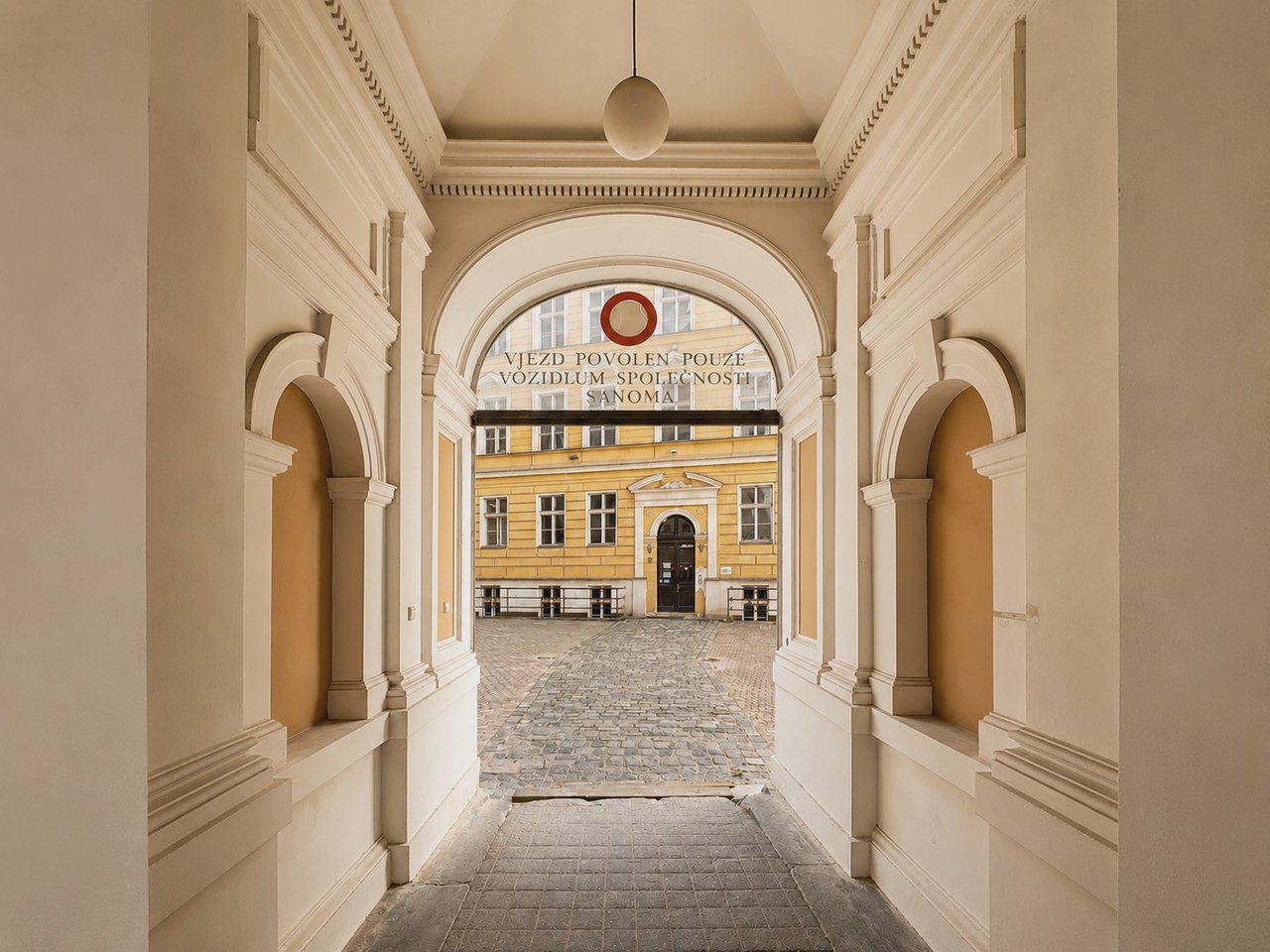
Why the house is limited to thirty companies
The cap of thirty companies is an operational decision, not a marketing gesture. It shapes how people work in the house, who your neighbours are, and why the address holds value. Fewer companies mean more available shared spaces, greater quiet, and an address that is not diluted among hundreds of entities.
Read
Ready-made s.r.o. vs starting a company from scratch
There are two ways to obtain a company in Czechia: buy a ready-made s.r.o., or set one up from scratch. A ready-made company is available immediately for a premium; setting up from scratch is cheaper and, thanks to direct registration by a notary, also fast today. The choice depends on how quickly you need the company.
Read
Changing a company seat in Czechia: the procedure
Changing a company seat in Czechia has two scenarios, and the wording of the founding deed decides between them. If the deed states only the municipality and the seat changes within it, the managing director decides. If the municipality changes or the deed contains a specific address, a decision of the general meeting in the form of a notarial deed is needed.
Read
Business loan in Czechia: what documents banks require
When applying for a business loan, a bank in Czechia decides on the basis of a company's figures and history. It requires, in particular, tax returns and financial statements for the recent periods, account statements, documents about the company and its obligations, and proof of no arrears. On this basis it assesses the company's creditworthiness and its ability to repay the loan.
Read
Setting up a Czech s.r.o. as a foreigner
A foreign person can set up an s.r.o. in Czechia and be its shareholder and managing director without a residence permit, even from outside the EU. The company can also be set up at a distance through a power of attorney. The differences from a domestic founder concern mainly proof of good standing and checks under anti-money-laundering rules.
Read
Tax returns in Czechia: deadlines and obligations
An income tax return is filed in Czechia within one of three possible deadlines, depending on how you file it and who prepares it: by 1 April on paper, by 1 May electronically and by 1 July if it is prepared by a tax adviser or the company is subject to audit. Companies and people with a data box file electronically as a matter of obligation.
Read
Documents to register a company seat in Czechia
To register a company seat in the commercial register in Czechia, you must prove you are allowed to use the address. The basis is the property owner's consent to placing the seat there, with an officially verified signature, accompanied by a cadastre extract. An alternative is a lease with the owner's explicit consent.
Read
How to get a trade licence in Czechia
You get a trade licence in Czechia at any trade licensing office or Czech POINT by filling in a single registration form. The fee is CZK 1,000 and you usually receive an extract with your assigned IČO (company ID) within 5 working days.
Read
Employee or contractor in Czechia? Where the švarcsystém line runs
A company can get work done either by an employee or through cooperation with a sole trader. The difference is not merely formal — and when cooperation on a trade licence actually replaces ordinary employment, it is the illegal švarcsystém, punishable by penalties in the millions and back-assessment of contributions and tax.
Read
Sole trader taxes in Czechia: flat-rate tax vs actual expenses
A sole trader in Czechia has three ways to tax their income: expense allowances, actual expenses and the flat-rate tax. The choice affects not only the amount of tax and contributions, but also the volume of administration. The most advantageous option is determined by the ratio of actual costs to income and the overall turnover.
Read
Virtual office vs private office vs flexdesk: what to choose
When looking for space for your company you choose between three formats: a virtual office (address only), a flexdesk in a coworking space (a shared spot) and a private office (your own space). They differ in cost, prestige and the degree of physical presence — and each suits a different kind of company.
Read
Doing business in Czechia as a foreigner: what to arrange before you start
Before you start doing business in Czechia, it pays to resolve four things: whether you need a residence permit, which form of business to choose, where your registered seat will be, and how you will prove good standing. Good preparation shortens the setup to a few days.
Read
Corporate income tax for an s.r.o. in Czechia: rates, dividends, costs
An s.r.o.'s profit is taxed in Czechia at 21 %, and when a share of profit is distributed, by a further 15 % withholding tax — together this is double taxation with an effective rate of around 33 %. The tax base is reduced by tax-deductible costs, depreciation of assets and any tax loss claimed.
Read
How to set up an s.r.o. in Czechia: procedure, costs and timing
An s.r.o. in Czechia is set up by a founding deed at a notary, paying up the capital, obtaining a trade licence and registration in the commercial register. With direct registration by a notary the company can be founded within a few days, and the share capital can be as little as CZK 1.
Read
Company seat in central Prague: why the address matters
A seat address is not just an administrative entry in the commercial register. It is the first impression clients, partners and banks form of the company, and a signal of how the company comes across. A prestigious address in central Prague says something different from an anonymous address on the periphery — and that difference matters more than it seems.
Read
Employing people in Czechia: employer obligations
Employing a person in Czechia means three kinds of obligation at once: registering them, remitting contributions and tax for them, and observing labour-law rules. Contributions on the employer's side are 33.8 % of the gross wage, the minimum wage in 2026 is CZK 22,400, and from 1 Jan 2026 a unified monthly employer report (JMHZ) applies.
Read
Sole trader or limited company in Czechia: which is worth it
A trade licence in Czechia is worth it for low costs, simple administration and a cheaper start; an s.r.o. is worth it at higher turnover, when you need to limit liability and build a brand. What decides is the level of income, the degree of risk and the tax impact.
Read
VAT in Czechia: when to register and the rates
VAT in Czechia has two rates — a standard 21 % and a reduced 12 %. A company becomes a VAT payer compulsorily after exceeding a turnover of CZK 2,000,000 per calendar year, or voluntarily earlier. Registration brings regular returns, control statements and the right to deduct input VAT.
Read
Virtual office address in Czechia: what it is and when it's worth it
A virtual office is a company's official address entered in the commercial register without you physically working there. In Czechia it is entirely legal, provided you have the owner's consent and the address is genuinely reachable for the authorities and post. It suits companies that don't need permanent premises.
Read
Why foreign entrepreneurs choose Czechia
Foreign entrepreneurs choose Czechia for its location in the heart of Europe and access to the EU single market, the ease and low cost of setting up a company, and a predictable environment. A company can be founded here even without residence, with share capital from CZK 1 and statutory fees around CZK 8,540.
Read